
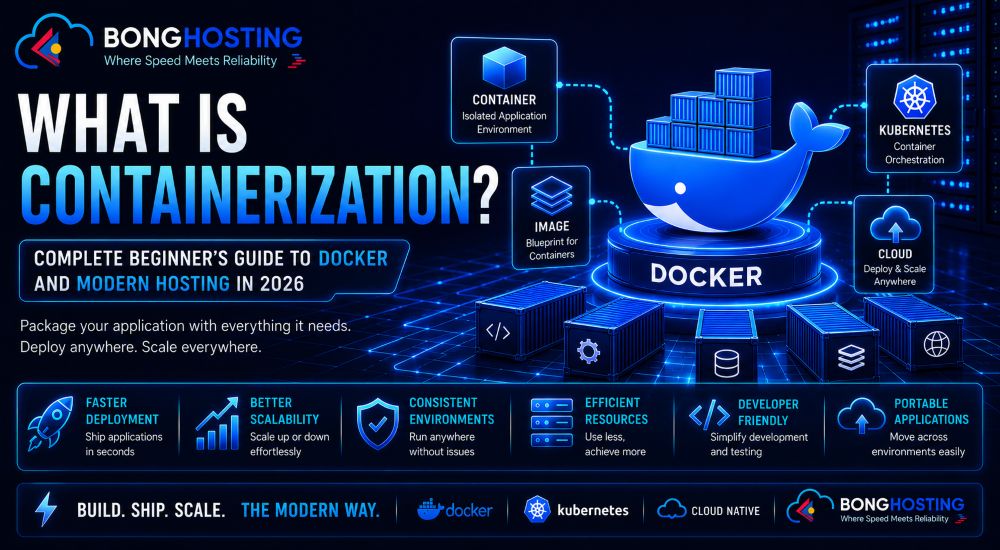
What Is Containerization? Complete Beginner’s Guide to Docker and Modern Hosting in 2026
Modern software development and web hosting have changed dramatically over the last few years.
Today’s applications need:
- Faster deployment
- Better scalability
- Consistent performance
- Flexible infrastructure
- Reliable cloud environments
- Efficient resource usage
Traditional application deployment methods often struggle to meet these demands.
This is where containerization becomes extremely important.
Containerization is one of the most important technologies behind:
- Modern cloud hosting
- DevOps workflows
- Kubernetes infrastructure
- Scalable applications
- Microservices architecture
- Continuous deployment systems
In 2026, container technology powers many of the world’s largest applications and cloud platforms.
This beginner-friendly guide will explain:
- What containerization means
- How containers work
- Containers vs virtual machines
- Docker basics
- Kubernetes basics
- Container orchestration
- Container security
- Benefits of containerization
- Common beginner mistakes
- Future of containerization in 2026
Let’s understand everything step-by-step.
What Is Containerization?
Containerization is a technology that packages applications along with their dependencies into isolated environments called containers.
A container includes:
- Application code
- Libraries
- Dependencies
- Runtime environment
- Configuration files
This allows applications to run consistently across different systems.
Why Containerization Is Important
Modern applications often run across:
- Cloud servers
- Development systems
- Production environments
- Hybrid infrastructure
Without containerization:
- Compatibility issues occur
- Deployment becomes difficult
- Scaling becomes complex
Containerization solves these problems by creating portable environments.
How Containers Work

Containers use operating system-level virtualization.
Instead of virtualizing entire hardware systems:
- Containers share the host operating system kernel
- Applications remain isolated
- Resources are used efficiently
This makes containers lightweight and fast.
Containers vs Virtual Machines

Virtual Machines
Virtual machines include:
- Full operating systems
- Virtualized hardware
- Larger resource usage
Advantages:
- Strong isolation
- Independent operating systems
Disadvantages:
- Higher resource consumption
- Slower startup time
Containers
Containers share the host operating system.
Advantages:
- Lightweight
- Faster deployment
- Better scalability
Disadvantages:
- Shared kernel dependency
What Is Docker?
Docker is the world’s most popular containerization platform.
Docker allows developers to:
- Build containers
- Deploy applications
- Manage environments
- Simplify software delivery
Docker made containerization widely accessible.
How Docker Works

Docker usually works like this:
- Developer creates application
- Docker image is built
- Container is created from image
- Application runs consistently
- Containers can scale easily
Docker images act like blueprints for containers.
What Is Kubernetes?

Kubernetes is a container orchestration platform.
It helps manage:
- Multiple containers
- Scaling
- Networking
- Automation
- Deployment
Large cloud environments often use Kubernetes.
Container Orchestration
Container orchestration means managing large numbers of containers automatically.
This includes:
- Auto-scaling
- Health monitoring
- Load balancing
- Failover management
- Resource allocation
Kubernetes is the most popular orchestration system in 2026.
Containerization and Cloud Hosting

Modern cloud hosting heavily depends on containers.
Containers improve:
- Scalability
- Resource efficiency
- Application portability
- Infrastructure automation
Major cloud providers use container technology extensively.
Containerization and DevOps

DevOps focuses on faster software delivery and automation.
Containers help DevOps teams:
- Deploy faster
- Reduce errors
- Improve consistency
- Automate workflows
Containerization is a core part of modern DevOps infrastructure.
Microservices and Containerization
Modern applications often use microservices architecture.
Instead of one large application:
- Multiple smaller services run independently
Containers are ideal for:
- Microservices deployment
- Independent scaling
- Faster updates
Benefits of Containerization

Faster Deployment
Containers start quickly.
Better Scalability
Applications scale more efficiently.
Consistent Environments
Applications behave consistently across systems.
Efficient Resource Usage
Containers use fewer resources than virtual machines.
Simplified Development
Developers work in predictable environments.
Improved Portability
Applications move easily between environments.
Container Security Basics
Containers also require proper security management.
Image Security
Container images should come from trusted sources.
Isolation Protection
Containers isolate applications from each other.
Access Control
Proper permissions are important.
Regular Updates
Container software should remain updated.
Common Uses of Containerization
Containers are widely used for:
- Cloud hosting
- Web applications
- DevOps pipelines
- SaaS platforms
- AI applications
- Microservices
- CI/CD systems
- Enterprise infrastructure
Containerization in Modern Hosting
Modern hosting providers use containers for:
- Scalable hosting
- Multi-tenant infrastructure
- Faster deployments
- Better uptime
- Resource optimization
Container hosting continues growing rapidly.
Common Beginner Mistakes
Confusing Containers with Virtual Machines
Containers and VMs are different technologies.
Ignoring Security
Containers still require strong security policies.
Using Untrusted Images
Unsafe container images may contain malware.
Poor Resource Management
Improper scaling may reduce performance.
Ignoring Monitoring Systems
Containers require active monitoring.
Best Practices for Containerization
- Use trusted container images
- Monitor container health
- Secure container access
- Keep software updated
- Use orchestration tools
- Enable backups
- Optimize scaling
- Monitor resource usage
Future of Containerization in 2026
Container technology continues evolving rapidly.
New innovations include:
- AI-powered orchestration
- Serverless containers
- Edge containerization
- Cloud-native security
- Intelligent scaling
- Automated optimization
Containers are becoming even more important in modern infrastructure.
Containerization and SEO
Containerization indirectly improves SEO through:
- Faster deployments
- Better uptime
- Improved website speed
- Reliable scalability
Modern hosting performance affects user experience and search rankings.
Conclusion
Containerization is one of the most important technologies behind modern cloud infrastructure and hosting systems.
Whether you run:
- Web applications
- Cloud platforms
- SaaS products
- Enterprise systems
- Modern hosting infrastructure
containerization helps improve:
- Scalability
- Reliability
- Deployment speed
- Resource efficiency
- Application portability
In 2026, understanding containerization is extremely valuable for developers, businesses, website owners, and anyone interested in the future of cloud hosting and modern infrastructure technology.
Start your website today from BongHosting.

