
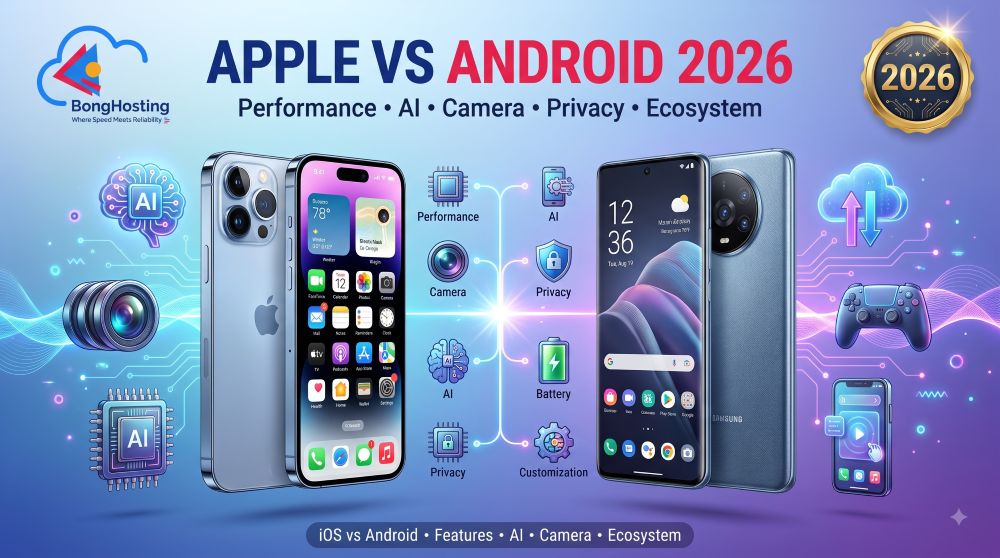
Apple vs Android in 2026: Which Smartphone Ecosystem Is Right for You?
The Apple vs Android debate has been running for years, but the smartphone market in 2026 looks very different from the one people knew a few years ago. Artificial intelligence has become a major part of mobile software, cameras have become computational photography systems, foldable phones are more mature, and smartphones increasingly work as the control center for computers, watches, tablets, cars and other connected devices.
That makes choosing between Apple and Android less about simply asking, “Which phone has better specifications?” The more useful question is: Which ecosystem matches the way you use technology?
Apple’s iPhone approach is built around tight integration between hardware and software. Android takes a broader approach, supporting phones from numerous manufacturers with different designs, specifications, interfaces and price ranges.
In 2026, both platforms offer powerful processors, advanced cameras, high-refresh-rate displays, 5G, AI features and sophisticated security systems. The major differences are found in the overall experience.
So, Apple vs Android in 2026 deserves a more detailed comparison.
Start Free Web Hosting Today with BongHosting
Launch your website with free web hosting — no upfront cost.
Apple vs Android: The Fundamental Difference

At its core, Apple controls both the iPhone hardware and iOS software. This gives Apple a high level of control over how the operating system interacts with the hardware.
Android follows a different model. Google develops Android, while manufacturers such as Samsung, Google, Xiaomi, OnePlus, Motorola and others build their own hardware and software experiences around it.
This creates two different philosophies.
Apple generally focuses on:
- Hardware and software integration
- A consistent interface
- Long-term ecosystem integration
- Controlled hardware choices
- Tight integration with other Apple products
- Privacy-focused system design
Android generally focuses on:
- Device variety
- Customization
- Different hardware designs
- Flexible software experiences
- Multiple price categories
- Features that vary between manufacturers
Neither approach is identical, and this distinction is one of the biggest reasons the Apple vs Android discussion continues.
Apple vs Android Performance in 2026
Raw processor specifications don’t tell the entire story.
Apple’s latest high-end iPhones use Apple’s own silicon, with the iPhone 18 Pro and iPhone 18 Pro Max using the A20 Pro chip. Apple lists a six-core CPU, seven-core GPU with Neural Accelerators and a dual 16-core Neural Engine for these models.
Android manufacturers use several processor platforms depending on the device. Flagship Android phones can also deliver extremely high CPU and GPU performance, particularly for gaming, multitasking and AI workloads.
The more important point is how the processor interacts with the operating system.
Apple can optimize iOS specifically for the hardware configurations it sells. Android has to operate across a much wider hardware ecosystem.
For everyday activities such as:
- Social media
- YouTube
- Web browsing
- Photography
- Video calls
- Online banking
- Messaging
both platforms can provide excellent performance.
For demanding gaming and professional workflows, however, you should compare the specific phones, rather than assuming every iPhone is faster than every Android device or vice versa.
Apple vs Android Camera Experience

Smartphone photography in 2026 is no longer simply about megapixel numbers.
Modern smartphones combine:
- Sensor hardware
- Computational photography
- AI processing
- HDR
- Image stabilization
- Lens selection
- Video processing
- Color science
The iPhone 18 Pro, for example, uses a 48MP Pro Fusion camera system with a variable-aperture main camera, 48MP ultra-wide camera and 48MP telephoto camera. Apple also provides controls for aperture, shutter speed and white balance.
Android manufacturers take different approaches. Some focus heavily on zoom, others on portrait photography, night photography, AI editing or extremely high-resolution sensors.
Therefore, instead of asking:
“Does Apple or Android have the better camera?”
consider what you photograph most.
For example:
- Video creators should examine video formats and stabilization.
- Travel photographers should examine zoom and low-light performance.
- Social-media creators should examine skin tones and video processing.
- Casual users may care more about point-and-shoot consistency.
The camera comparison should always be made model-to-model.
Apple vs Android: Software and User Interface
iOS is designed around consistency.
Apple controls the iPhone hardware lineup and iOS experience, so moving between recent iPhones usually feels familiar.
Android is more diverse.
A Samsung phone may have a substantially different interface from a Google Pixel, OnePlus or Xiaomi device.
This can be an advantage for users who enjoy choosing how their phone looks and behaves.
Android often provides more flexibility around:
- Home-screen layouts
- Widgets
- Default applications
- Launchers
- File management
- Multitasking
- Split-screen functionality
- System customization
iOS has become more flexible over time, but Apple’s design philosophy still prioritizes a controlled and consistent experience.
Customization: Android vs iPhone
Customization is one of the clearest differences in the Apple vs Android comparison.
Android has historically provided more freedom to change the appearance and behavior of the operating system.
Depending on the manufacturer and Android version, users can customize:
- Launchers
- Icons
- Widgets
- Default apps
- Home screens
- Notification behavior
- Multitasking layouts
- Wallpapers
- Quick settings
iPhone users can also customize widgets, Home Screen layouts, Lock Screens and other elements, but Apple maintains tighter system-level boundaries.
For users who enjoy experimenting with their phone, Android can provide a broader range of customization options.
For users who prefer a consistent interface that requires less configuration, iOS can feel simpler.
Apple vs Android and Artificial Intelligence in 2026

AI has become one of the biggest smartphone battlegrounds in 2026.
Apple’s current Apple Intelligence system combines on-device processing with Private Cloud Compute for more demanding requests. Apple says that data sent to Private Cloud Compute for supported requests is not stored or made accessible to Apple, while independent researchers can verify aspects of its privacy architecture.
Apple’s 2026 software also includes a substantially more capable Siri AI experience, although availability varies by language and region.
Android’s AI strategy is broader because Google and individual manufacturers can integrate different AI services into their devices. Google continues to add capabilities such as Gemini-related experiences and Circle to Search.
This means the AI comparison should not simply be:
Apple = AI
Android = AI
Both platforms use AI extensively.
The actual differences involve:
- Which AI model is being used
- Where processing happens
- Which apps can access AI functions
- Regional availability
- Language support
- Manufacturer-specific features
- Cloud versus on-device processing
AI features can also change quickly through software updates, making this an area where today’s comparison may not remain identical next year.
Privacy and Security
Privacy is another major area where Apple and Android take different approaches.
Apple strongly emphasizes privacy as part of its product architecture. Its Apple Intelligence system uses on-device processing for many tasks and Private Cloud Compute for more demanding workloads.
Android also has extensive security mechanisms. Google says Play Protect-certified Android devices undergo security testing and include Google Play Protect, which provides features such as automatic malware scanning and Find My Device.
However, Android’s security experience can vary because Android phones come from many manufacturers.
Therefore, when purchasing an Android phone, it is useful to check:
- Security update policy
- Update frequency
- Manufacturer support period
- Play Protect certification
- Bootloader policies
- Privacy controls
Security is not determined only by the operating system name.
Apple Ecosystem vs Android Ecosystem

The ecosystem may be more important than the phone itself.
Apple’s ecosystem connects devices such as:
- iPhone
- Mac
- iPad
- Apple Watch
- AirPods
- Apple TV
Features such as AirDrop, iCloud, Handoff and Continuity can make switching between Apple devices convenient.
Android has a broader ecosystem rather than one single hardware ecosystem. Depending on the manufacturer, you may connect an Android phone with:
- Windows PCs
- Chromebooks
- Android tablets
- Smartwatches
- Wireless earbuds
- Smart TVs
- Cars
- Smart-home devices
Google also provides services such as Quick Share, Google Drive, Google Photos, Google Meet and Google Wallet.
This means the best ecosystem depends heavily on the devices you already own.
Gaming: Apple vs Android
Gaming performance depends heavily on the specific device.
High-end iPhones offer powerful GPUs and optimized games. Apple’s current A20 Pro chip also includes hardware-accelerated ray tracing.
Android has an enormous gaming ecosystem, including phones specifically designed around gaming.
Some Android gaming phones provide:
- High-refresh-rate displays
- Gaming triggers
- Advanced cooling
- Large batteries
- Aggressive performance modes
If mobile gaming is important, compare the actual phones rather than choosing based solely on the operating system.
App Availability and Software Experience
Both platforms have mature app ecosystems.
Major applications such as:
- YouTube
- Spotify
- Netflix
- Google Maps
- Microsoft 365
- Adobe apps
are available across both platforms.
The differences can appear in app optimization, feature timing and platform-specific integrations.
For developers, Apple’s controlled hardware ecosystem can simplify optimization for iPhone models.
Android development requires consideration of a much larger range of screen sizes, processors, manufacturers and software configurations.
Need Fast Mumbai Server Hosting?
Host your website on a Mumbai-based server with BongHosting.
Apple vs Android: Master Comparison

| Category | Apple / iPhone | Android |
|---|---|---|
| Operating system | iOS | Android |
| Hardware choice | Apple-designed lineup | Many manufacturers |
| Customization | Increasing but controlled | Generally broader |
| AI | Apple Intelligence | Gemini and manufacturer AI |
| Ecosystem | Highly integrated Apple ecosystem | Broad multi-brand ecosystem |
| Gaming | Strong flagship performance | Strong flagship + gaming phones |
| Camera | Strong computational photography | Wide range of approaches |
| Updates | Centrally controlled by Apple | Depends on manufacturer |
| Price range | Primarily mid/high/premium | Budget to ultra-premium |
| Foldables | iPhone Duo introduced in 2026 | Many established foldable options |
| File management | More controlled | Generally more flexible |
| Hardware variety | Limited compared with Android | Extremely broad |
| PC integration | Strong with Mac | Strong with Windows/ChromeOS |
| Customization | Moderate | High |
| User experience | Consistent | Highly variable by manufacturer |
Which Should You Consider in 2026?
Instead of declaring one operating system universally better, consider your priorities.
An iPhone may make more sense if you value:
- Apple ecosystem integration
- Consistent software experience
- Long-term hardware/software integration
- Video recording
- Apple Watch integration
- Mac integration
- Apple’s privacy architecture
Android may make more sense if you value:
- Greater hardware choice
- More customization
- Different price levels
- Foldable options
- Gaming-focused phones
- File-system flexibility
- Manufacturer-specific features
The decision should begin with your usage pattern rather than brand loyalty.
What About Web Hosting, Business and Productivity?
For people who manage websites, hosting accounts or online businesses, both platforms can work extremely well.
A business owner may need:
- Browser-based hosting control panels
- WordPress management
- Cloud storage
- Banking applications
- Password managers
- Website analytics
- Social-media management
- Remote server access
Most of these tasks are platform-independent.
For a hosting business such as BongHosting, the important factor is not whether a customer uses iPhone or Android. The website and hosting service should provide a responsive experience across both platforms.
That is an important principle for website owners as well: don’t design your website around only one mobile ecosystem.
Final Thoughts on Apple vs Android in 2026
The Apple vs Android debate has evolved.
It is no longer simply a discussion about processor speed, camera megapixels or screen size. In 2026, the more important questions involve AI, privacy, software support, ecosystem integration, customization, device variety and how the smartphone fits into your digital life.
Apple offers a tightly integrated hardware-and-software approach, while Android gives users a much broader range of manufacturers and experiences.
If you are choosing a phone, compare the specific models, software support, features and total ecosystem rather than relying on the Apple-versus-Android label alone.
The best smartphone experience is ultimately the one that matches the way you actually use your technology.
👉 Visit BongHosting.com for fast, reliable hosting — starting at just ₹99/month!
Start Cheap Web Hosting Today
Get reliable web hosting at an affordable price with BongHosting.

