
What Is Edge Computing? Complete Beginner’s Guide to Faster Web Infrastructure in 2026
Modern websites and online applications require extremely fast performance.
Today’s internet users expect:
- Instant loading
- Low latency
- Real-time responses
- Fast streaming
- Smooth gaming
- Reliable cloud services
Traditional cloud infrastructure alone sometimes cannot deliver ultra-fast response times for modern applications.
This is where edge computing becomes extremely important.
Edge computing is one of the most advanced technologies behind:
- Modern CDNs
- Smart web applications
- Streaming platforms
- Cloud gaming
- IoT systems
- AI-powered services
- Real-time processing systems
In 2026, edge computing is becoming a major part of modern hosting and internet infrastructure.
This beginner-friendly guide will explain:
- What edge computing means
- How edge servers work
- Difference between cloud and edge computing
- Edge computing and CDN technology
- Low latency infrastructure
- Real-time processing
- Security advantages
- Edge computing use cases
- Common beginner mistakes
- Future of edge computing in 2026
Let’s understand everything step-by-step.
What Is Edge Computing?
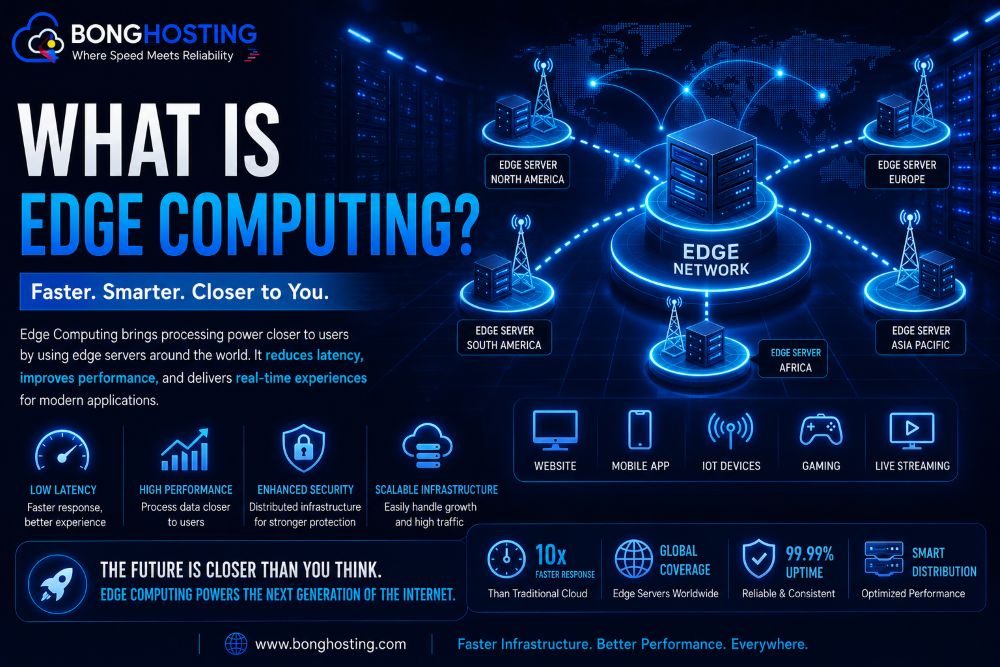
Edge computing is a technology where data processing happens closer to users instead of relying only on centralized cloud servers.
Instead of sending all data to a distant data center:
- Processing occurs near the network edge
- Response time becomes faster
- Latency is reduced
This improves performance significantly.
Why Edge Computing Is Important
Modern applications require real-time performance.
Examples include:
- Video streaming
- Online gaming
- Smart devices
- AI systems
- Live applications
Without edge computing:
- Latency increases
- Delays occur
- User experience suffers
Edge infrastructure solves these problems.
How Edge Computing Works

Edge computing usually works like this:
- User sends a request
- Request reaches nearby edge server
- Data is processed locally
- Response is delivered quickly
- Central cloud servers handle larger tasks
This reduces the distance data must travel.
What Is an Edge Server?

An edge server is a server placed closer to users geographically.
These servers help:
- Deliver content faster
- Reduce latency
- Improve performance
- Handle local traffic efficiently
Edge servers are commonly used in:
- CDN networks
- Streaming platforms
- Gaming services
- Cloud applications
Cloud Computing vs Edge Computing

Cloud Computing
Traditional cloud computing uses centralized data centers.
Advantages:
- Massive scalability
- Centralized management
- High storage capacity
Disadvantages:
- Higher latency for distant users
Edge Computing
Edge computing processes data near users.
Advantages:
- Lower latency
- Faster responses
- Real-time performance
Disadvantages:
- More complex infrastructure
Edge Computing and CDN

Many beginners confuse edge computing with CDN technology.
CDN
A CDN mainly delivers cached content quickly.
Examples:
- Images
- Videos
- Website files
Edge Computing
Edge computing goes further by:
- Processing data locally
- Running applications near users
- Handling real-time workloads
Modern CDN platforms often include edge computing features.
Edge Computing and Website Speed
Edge computing greatly improves:
- Website loading speed
- Server response time
- User experience
Faster websites reduce:
- Bounce rate
- User frustration
- Loading delays
Edge Computing and Low Latency

Latency means delay between request and response.
Edge computing reduces latency by:
- Minimizing network distance
- Processing data locally
- Reducing routing delays
This is essential for:
- Online gaming
- Video calls
- Streaming
- Financial systems
- Real-time applications
Real-Time Processing with Edge Computing

Modern applications often require instant data processing.
Edge computing supports:
- Live streaming
- AI inference
- Smart cameras
- IoT devices
- Real-time analytics
This enables faster decision-making.
Edge Computing in Web Hosting
Modern hosting providers increasingly use edge infrastructure.
Benefits include:
- Faster website delivery
- Better uptime
- Improved scalability
- Lower latency
Edge-enabled hosting improves global performance.
Edge Computing and Security
Edge computing also improves security in several ways.
Distributed Infrastructure
Traffic is distributed across multiple edge nodes.
Faster Threat Detection
Edge systems can detect attacks faster.
Reduced Centralized Risk
Data is not always dependent on one central location.
Better DDoS Protection
Distributed infrastructure helps absorb traffic attacks.
Common Uses of Edge Computing
Edge computing is widely used for:
- Streaming platforms
- Online gaming
- Smart cities
- IoT systems
- Healthcare systems
- AI applications
- Autonomous vehicles
- CDN infrastructure
Edge Computing for Gaming and Streaming
Gaming and streaming require:
- Low latency
- Fast response time
- Real-time communication
Edge servers help reduce lag and buffering.
Edge AI and Smart Applications
Modern AI systems increasingly use edge computing.
Examples include:
- Smart cameras
- Voice assistants
- Real-time AI analysis
This improves processing speed dramatically.
Common Beginner Mistakes
Thinking Edge Computing Replaces Cloud Computing
Edge and cloud systems usually work together.
Ignoring Network Infrastructure
Poor networking reduces edge performance.
Confusing CDN with Full Edge Computing
CDN caching and edge processing are different technologies.
Underestimating Infrastructure Complexity
Edge systems require advanced infrastructure planning.
Ignoring Security Layers
Edge infrastructure still requires strong security controls.
Benefits of Edge Computing

Lower Latency
Users receive faster responses.
Better Website Speed
Content and applications load faster.
Improved User Experience
Users experience smoother performance.
Reduced Bandwidth Usage
Local processing reduces central server load.
Better Scalability
Distributed infrastructure supports growth efficiently.
Best Practices for Edge Computing
- Use reliable CDN providers
- Optimize network routing
- Monitor edge performance
- Secure edge servers properly
- Use distributed infrastructure
- Test latency regularly
- Monitor traffic patterns
- Use modern cloud integration
Future of Edge Computing in 2026
Edge computing is evolving rapidly.
New innovations include:
- Edge AI systems
- 5G edge infrastructure
- Smart city integration
- Autonomous systems
- Real-time machine learning
- Intelligent traffic optimization
Edge computing is becoming one of the most important technologies in modern internet infrastructure.
Edge Computing and SEO
Edge computing indirectly improves SEO through:
- Faster website speed
- Lower latency
- Better uptime
- Improved user experience
Search engines prefer fast and reliable websites.
Conclusion
Edge computing is transforming modern web infrastructure and hosting technology.
Whether you run:
- A website
- Streaming platform
- Gaming service
- Cloud application
- Enterprise system
edge computing helps improve:
- Website speed
- Scalability
- Reliability
- Low latency performance
- User experience
In 2026, understanding edge computing is extremely valuable for website owners, developers, businesses, and anyone interested in the future of internet infrastructure.
Start your website today from BongHosting.

