
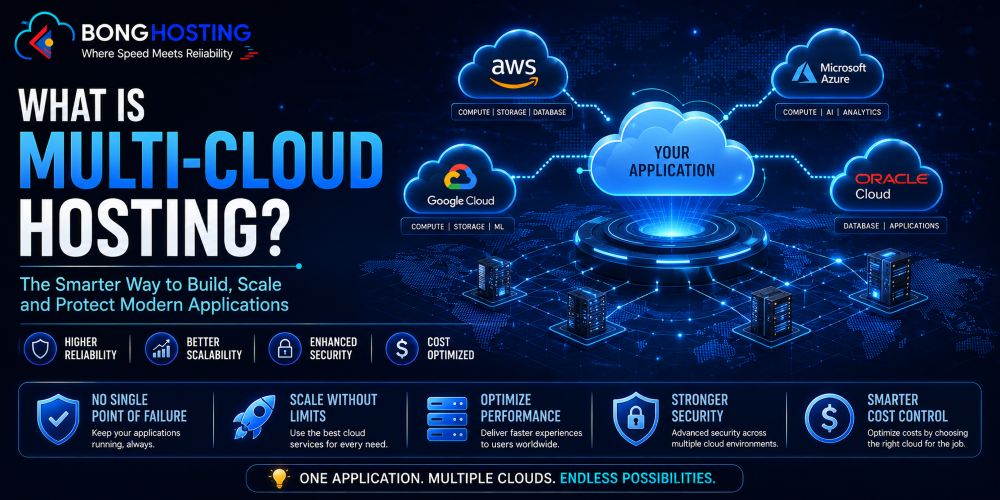
What Is Multi-Cloud Hosting? Complete Beginner’s Guide to Multi-Cloud Infrastructure in 2026
Modern businesses increasingly rely on cloud infrastructure to run websites, applications, databases, and online services.
Today’s organizations need:
- Better uptime
- Stronger security
- Faster performance
- Flexible infrastructure
- Global scalability
- Reliable disaster recovery
Relying on a single cloud provider sometimes creates limitations and risks.
This is where multi-cloud hosting becomes extremely important.
Multi-cloud hosting is becoming one of the most important strategies behind:
- Enterprise cloud infrastructure
- High-availability systems
- Global applications
- Scalable SaaS platforms
- Disaster recovery systems
- Cloud-native applications
In 2026, many businesses use multiple cloud providers to improve performance and reliability.
This beginner-friendly guide will explain:
- What multi-cloud hosting means
- Single cloud vs multi-cloud
- Hybrid cloud vs multi-cloud
- How multi-cloud infrastructure works
- Security advantages
- Scalability benefits
- Cloud redundancy and failover
- Common beginner mistakes
- Future of multi-cloud infrastructure in 2026
Let’s understand everything step-by-step.
What Is Multi-Cloud Hosting?
Multi-cloud hosting is a cloud strategy where businesses use services from multiple cloud providers instead of relying on only one provider.
For example:
- One provider may host applications
- Another may handle backups
- Another may manage AI services
This creates a more flexible infrastructure.
Why Multi-Cloud Hosting Is Important
Using only one cloud provider may create:
- Vendor dependency
- Limited redundancy
- Downtime risks
- Geographic limitations
Multi-cloud hosting helps reduce these problems.
Single Cloud vs Multi-Cloud

Single Cloud Infrastructure
Single cloud means using only one provider.
Advantages:
- Simpler management
- Easier deployment
- Lower complexity
Disadvantages:
- Higher vendor dependency
- Single point of failure
- Limited flexibility
Multi-Cloud Infrastructure
Multi-cloud uses multiple cloud providers together.
Advantages:
- Better redundancy
- Improved flexibility
- Higher availability
- Better scalability
Disadvantages:
- More complex management
- Higher configuration complexity
Multi-Cloud vs Hybrid Cloud

Many beginners confuse multi-cloud with hybrid cloud.
Hybrid Cloud
Hybrid cloud combines:
- Private cloud
- Public cloud
- On-premise infrastructure
Multi-Cloud
Multi-cloud focuses on using:
- Multiple public cloud providers
- Different cloud services together
Both technologies may work together.
How Multi-Cloud Infrastructure Works

Multi-cloud infrastructure usually works like this:
- Applications are distributed across providers
- Traffic is balanced intelligently
- Data may replicate between clouds
- Failover systems improve uptime
- Workloads scale dynamically
This improves resilience and flexibility.
Cloud Redundancy and Failover

One major advantage of multi-cloud hosting is redundancy.
If one cloud provider experiences:
- Downtime
- Outages
- Performance issues
another provider may continue serving applications.
Failover systems automatically redirect traffic.
Multi-Cloud Scalability

Multi-cloud infrastructure improves scalability significantly.
Businesses can:
- Expand globally
- Use regional cloud providers
- Scale workloads dynamically
- Optimize cloud resources
This improves overall flexibility.
Multi-Cloud Performance Optimization
Different cloud providers offer:
- Different strengths
- Regional performance advantages
- Specialized services
Businesses can optimize workloads based on performance requirements.
Multi-Cloud Security
Multi-cloud hosting also improves security in many cases.
Reduced Vendor Risk
Businesses avoid depending fully on one provider.
Disaster Recovery
Multi-cloud backups improve business continuity.
Multi-Cloud Hosting and Modern Applications
Modern applications increasingly use multi-cloud strategies for:
- SaaS platforms
- AI applications
- Enterprise systems
- Streaming platforms
- Global applications
- Large-scale APIs
Multi-cloud infrastructure supports modern scalability demands.
Multi-Cloud and DevOps
DevOps teams use multi-cloud systems for:
- Flexible deployments
- Better automation
- Improved redundancy
- Faster global delivery
Cloud-native DevOps workflows often support multi-cloud deployment.
Common Beginner Mistakes
Thinking Multi-Cloud Eliminates All Downtime
Proper configuration is still necessary.
Ignoring Cloud Management Complexity
Multi-cloud systems require advanced management.
Poor Security Configuration
Each cloud provider requires proper security controls.
Weak Networking Setup
Poor networking reduces multi-cloud performance.
Ignoring Monitoring Systems
Multi-cloud environments require continuous monitoring.
Benefits of Multi-Cloud Hosting

Better Reliability
Applications remain available during outages.
Improved Scalability
Infrastructure grows dynamically.
Reduced Vendor Dependency
Businesses gain flexibility.
Better Global Performance
Regional cloud optimization improves speed.
Stronger Disaster Recovery
Multi-cloud backup systems improve resilience.
Best Practices for Multi-Cloud Hosting
- Use centralized monitoring
- Secure all cloud environments
- Optimize cloud networking
- Enable failover systems
- Monitor cloud costs carefully
- Use automation tools
- Test disaster recovery regularly
- Optimize workload placement
Future of Multi-Cloud Infrastructure in 2026
Multi-cloud technology continues evolving rapidly.
New innovations include:
- AI-powered workload balancing
- Intelligent cloud optimization
- Multi-cloud automation
- Advanced cloud security
- Cloud-native orchestration
- Edge and multi-cloud integration
Multi-cloud infrastructure is becoming increasingly important for modern businesses.
Multi-Cloud Hosting and SEO
Multi-cloud infrastructure indirectly improves SEO through:
- Better uptime
- Faster performance
- Improved global delivery
- Better user experience
Reliable websites perform better in search engines.
Conclusion
Multi-cloud hosting is transforming modern cloud infrastructure and enterprise hosting strategies.
Whether you run:
- SaaS platforms
- Enterprise applications
- Global websites
- Streaming systems
- Cloud-native applications
multi-cloud hosting helps improve:
- Reliability
- Scalability
- Security
- Disaster recovery
- Global performance
In 2026, understanding multi-cloud hosting is extremely valuable for businesses, developers, website owners, and anyone interested in the future of cloud infrastructure and enterprise hosting technology.
Start your website today from BongHosting.

