
What Is Serverless Computing? Complete Beginner’s Guide to Modern Cloud Applications in 2026
Modern web applications are becoming faster, smarter, and more scalable every year.
Today’s businesses want:
- Faster application deployment
- Automatic scaling
- Lower infrastructure management
- Better cost efficiency
- High availability
- Flexible cloud infrastructure
Traditional server management often becomes complex and time-consuming.
This is where serverless computing becomes extremely important.
Serverless computing is one of the fastest-growing technologies behind:
- Modern cloud applications
- Event-driven systems
- Scalable APIs
- Microservices architecture
- Cloud automation
- Real-time applications
In 2026, many modern cloud platforms heavily use serverless architecture.
This beginner-friendly guide will explain:
- What serverless computing means
- How serverless architecture works
- Serverless vs traditional hosting
- Cloud functions basics
- AWS Lambda basics
- Auto scaling
- Benefits of serverless computing
- Security basics
- Common beginner mistakes
- Future of serverless computing in 2026
Let’s understand everything step-by-step.
What Is Serverless Computing?
Serverless computing is a cloud computing model where developers run applications without managing physical servers directly.
The cloud provider automatically handles:
- Server management
- Infrastructure scaling
- Resource allocation
- Maintenance
- Availability
Developers mainly focus on writing application code.
Why Serverless Computing Is Important
Traditional infrastructure requires:
- Server setup
- Maintenance
- Scaling management
- Monitoring
- Operating system updates
This increases complexity.
Serverless computing simplifies deployment and infrastructure management significantly.
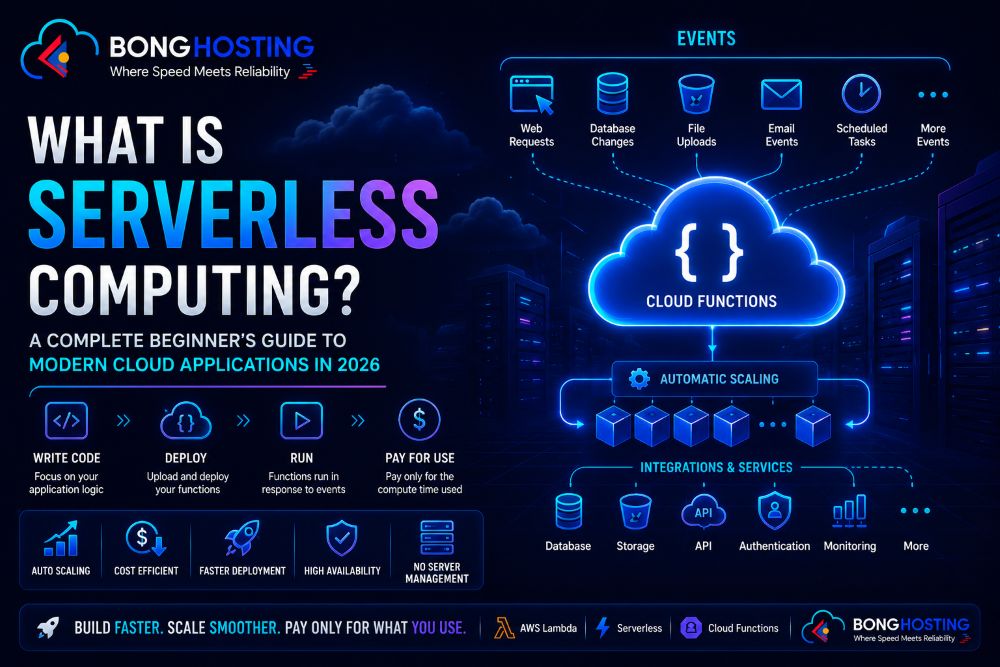
How Serverless Architecture Works

Serverless systems usually work like this:
- User triggers an event
- Cloud platform activates a function
- Code executes automatically
- Resources scale dynamically
- Function stops after execution
This process is highly automated.
What Are Cloud Functions?
Cloud functions are small pieces of code that run in response to events.
Functions can trigger from:
- API requests
- File uploads
- Database changes
- User actions
- Scheduled tasks
Cloud functions are core components of serverless architecture.
Traditional Hosting vs Serverless Computing

Traditional Hosting
Traditional hosting requires:
- Dedicated servers
- VPS management
- Operating system administration
- Manual scaling
Advantages:
- Full server control
- Custom configurations
Disadvantages:
- Higher maintenance
- Complex scaling
Serverless Computing
Serverless systems automatically manage infrastructure.
Advantages:
- Automatic scaling
- Lower management overhead
- Faster deployment
Disadvantages:
- Less infrastructure control
- Vendor dependency
What Is AWS Lambda?

AWS Lambda is one of the world’s most popular serverless platforms.
It allows developers to:
- Run code without managing servers
- Scale automatically
- Pay only for usage
AWS Lambda helped popularize serverless computing globally.
Event-Driven Architecture
Serverless computing commonly uses event-driven systems.
Examples of events:
- User login
- Payment processing
- File upload
- Form submission
- Database update
Functions execute only when events occur.
Auto Scaling in Serverless Computing

One major advantage of serverless architecture is automatic scaling.
The cloud platform automatically:
- Increases resources during traffic spikes
- Reduces resources during low usage
- Optimizes performance
This improves efficiency significantly.
Serverless Computing and Cloud Hosting
Modern cloud hosting increasingly uses serverless infrastructure.
Serverless systems improve:
- Scalability
- Deployment speed
- Cost efficiency
- Infrastructure automation
Many modern SaaS platforms use serverless architecture.
Serverless Computing and DevOps

Serverless computing fits well with DevOps practices.
Benefits include:
- Faster CI/CD pipelines
- Reduced operational management
- Automated deployment
- Better developer productivity
Serverless infrastructure accelerates modern development workflows.
Microservices and Serverless
Serverless architecture works extremely well with microservices.
Instead of one large application:
- Multiple smaller functions run independently
This improves:
- Scalability
- Flexibility
- Fault isolation
Benefits of Serverless Computing

Automatic Scaling
Infrastructure scales automatically.
Lower Operational Cost
Developers pay mainly for actual usage.
Faster Deployment
Applications deploy rapidly.
Reduced Infrastructure Management
Cloud providers manage servers automatically.
High Availability
Modern cloud providers offer reliable infrastructure.
Better Resource Efficiency
Resources are used dynamically.
Serverless Security Basics
Serverless applications still require proper security.
Access Control
Functions need proper permissions.
API Security
Public APIs require protection.
Event Validation
Incoming events should be validated carefully.
Monitoring and Logging
Continuous monitoring is important.
Common Uses of Serverless Computing
Serverless systems are widely used for:
- APIs
- Web applications
- Automation systems
- Chat applications
- Image processing
- File conversion
- IoT platforms
- Real-time applications
Common Beginner Mistakes
Thinking Serverless Means No Servers Exist
Servers still exist, but cloud providers manage them.
Ignoring Cold Start Delays
Some functions may start slower initially.
Poor Security Configuration
Serverless systems still require security controls.
Overusing Functions
Too many small functions can increase complexity.
Ignoring Monitoring Systems
Monitoring remains extremely important.
Best Practices for Serverless Computing
- Use proper access control
- Optimize function execution time
- Monitor cloud functions
- Secure APIs properly
- Use event validation
- Reduce unnecessary dependencies
- Optimize scaling configuration
- Enable logging and monitoring
Future of Serverless Computing in 2026
Serverless technology continues evolving rapidly.
New innovations include:
- AI-powered scaling
- Edge serverless systems
- Real-time cloud automation
- Intelligent workload optimization
- Multi-cloud serverless platforms
- Advanced event orchestration
Serverless computing is becoming a major part of future cloud infrastructure.
Serverless Computing and SEO
Serverless architecture indirectly improves SEO through:
- Faster website speed
- Better uptime
- Improved scalability
- Faster response times
Search engines favor reliable and fast web applications.
Conclusion
Serverless computing is transforming modern cloud infrastructure and web application deployment.
Whether you run:
- Web applications
- SaaS platforms
- APIs
- Automation systems
- Cloud-native applications
serverless computing helps improve:
- Scalability
- Cost efficiency
- Deployment speed
- Infrastructure automation
- Developer productivity
In 2026, understanding serverless computing is extremely valuable for developers, businesses, website owners, and anyone interested in modern cloud technologies and the future of hosting infrastructure.
Start your website today from BongHosting.

